Published 2026-07-31
What to Eat in Beijing: 15 Must-Try Dishes and Where to Find Them [2026]
From Peking duck to street-side jianbing: discover 15 essential Beijing dishes with specific restaurant recommendations, price ranges, and neighborhood guides for every budget.
Beijing’s food scene is one of the richest in the world — shaped by imperial banquets, Silk Road trade, and centuries of street-food tradition. This guide covers 15 essential dishes and snacks, from the obvious (Peking duck) to the deeply local (fermented bean juice), with specific restaurants where you can find each one done right.
Most first-time visitors underestimate how much Beijing has to offer beyond roast duck. The city is a breakfast capital (dozens of savory crepe and pancake variations), the birthplace of Mongolian hotpot as we know it, and home to a rich Islamic Chinese culinary tradition in the Niujie (Ox Street) neighborhood. Here’s where to start.
1. Peking Duck (北京烤鸭 Běijīng Kǎoyā)
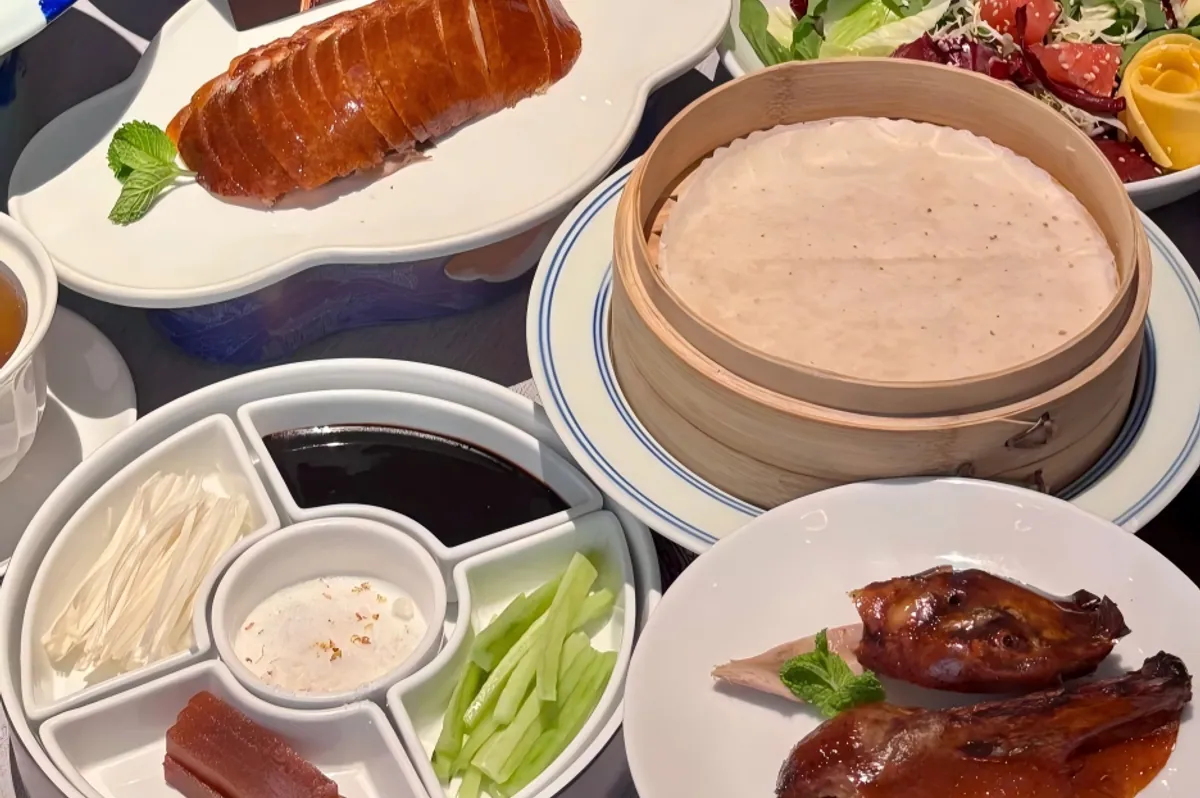
The undisputed icon of Beijing cuisine. A whole duck is air-dried, glazed with maltose, and roasted in a wood-fired oven until the skin is paper-thin and crackling-crisp. It’s carved tableside and served with thin pancakes, sweet bean sauce, cucumber, and scallions. The skin is the star — dip it in sugar for the traditional first bite.
Where to go: Siji Minfu (multiple locations, Dengshikou flagship is closest to the Forbidden City) is the locals’ pick — half the price of touristy Quanjude, twice the quality. Dadong (Tiantan Road location near the Temple of Heaven) does a refined, less fatty version with artistic presentation. Budget: Li Qun Roast Duck in a hutong courtyard near Qianmen, where ducks are roasted in a traditional brick oven.
2. Zhajiangmian (炸酱面 Zhájiàngmiàn)
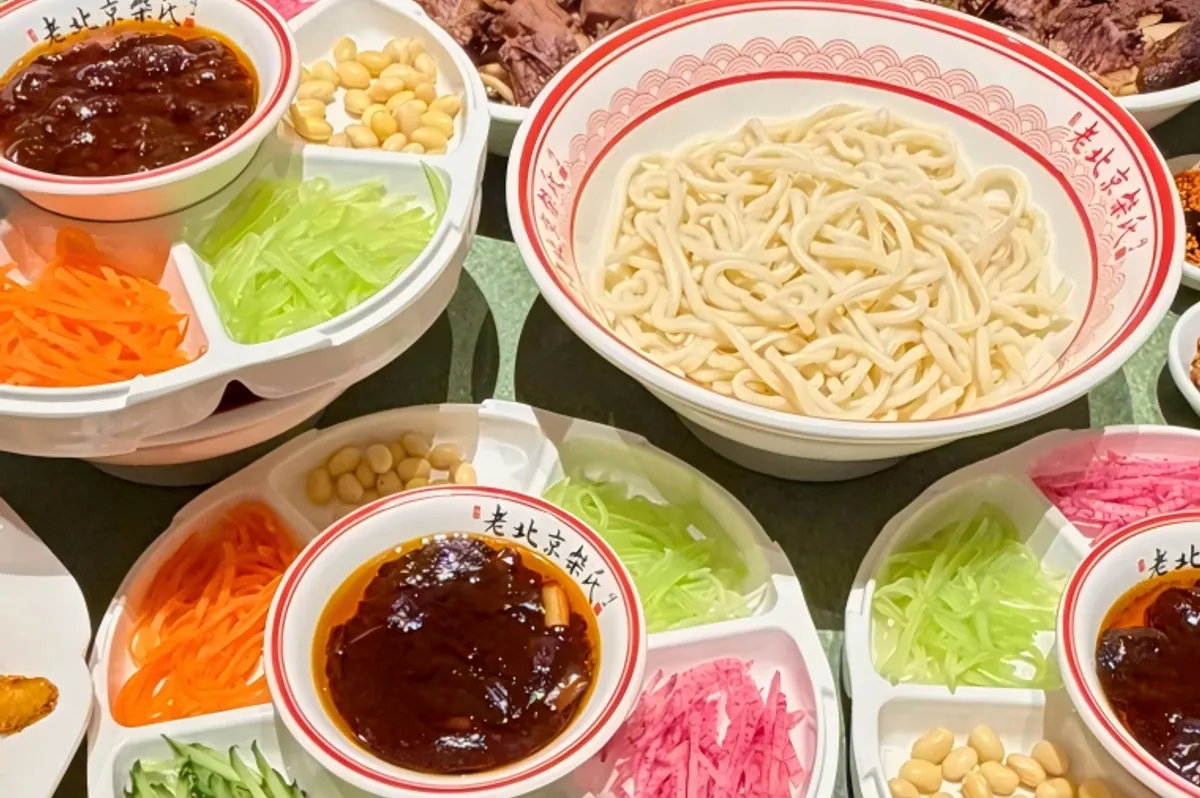
Beijing’s quintessential comfort food: thick wheat noodles topped with a rich, salty fermented soybean paste stir-fried with diced pork belly and served with a rainbow of fresh shredded vegetables (cucumber, radish, soybean sprouts). You mix everything at the table and eat it with raw garlic on the side. It’s a ¥15–25 meal that fills you for hours.
Where to go: Haiwanju on Zengguang Road in Haidian is the definitive version — the noodle-pulling happens in the front window. In Dongcheng, the zhajiangmian at Old Beijing Zhajiangmian King near the Lama Temple is a reliable introduction.
3. Mongolian Hotpot (涮羊肉 Shuàn Yángròu)
Paper-thin slices of lamb swished in a bubbling copper pot of broth until just cooked, then dipped in sesame sauce. This originated in Beijing during the Yuan Dynasty when Mongol soldiers would cook mutton in their helmets over campfires. The copper pot with a central chimney is a Beijing invention. Never order hotpot for one — it’s a communal meal.
Where to go: Donglaishun (multiple locations) is the century-old classic, founded in 1903. For a more local experience, Nanmen Hotpot near the Temple of Heaven gets consistently high marks. The sesame dipping sauce is non-negotiable — mix in cilantro, scallion, and a splash of the hot broth to thin it.
4. Jianbing (煎饼 Jiānbǐng)
The king of Beijing street breakfasts. A thin mung bean and grain crepe is spread on a hot griddle, cracked with an egg, sprinkled with scallions and cilantro, painted with chili and sweet bean sauce, folded around a crispy sheet of fried dough (baocui), and handed to you in a paper wrapper. Total cost: ¥6–10. Total time: 90 seconds. Best eaten immediately while the baocui is still crunchy.
Where to go: Street carts near residential neighborhoods in the morning (7–9am). The cart outside Dongsi subway station (Line 5/6, Exit B) is legendary. Look for a line of office workers — that’s your signal. Heizhima Hutong near Nanluoguxiang has a well-known stall that adds a second egg for ¥2 extra.
5. Dumplings (饺子 Jiǎozi)
Northern China is dumpling country, and Beijing has its own distinct tradition. Unlike Shanghai’s soup dumplings (xiaolongbao), Beijing jiaozi are larger, sturdier, and meant to be eaten in quantities of 15–20 per person. The classic filling is pork and Chinese cabbage, but lamb and coriander, egg and chive, and pork and fennel are equally traditional.
Where to go: Xian Lao Man near the Temple of Heaven is a Beijing institution — the dumplings are the size of a child’s fist, boiled to order. Mr. Shi’s Dumplings near the Drum Tower is more foreigner-friendly with an English menu and photos. For the full experience, visit a jiaozi guan (dumpling house) in any residential neighborhood and order by weight (liang) rather than piece count.
6. Donkey Burger (驴肉火烧 Lǚ ròu Huǒshāo)
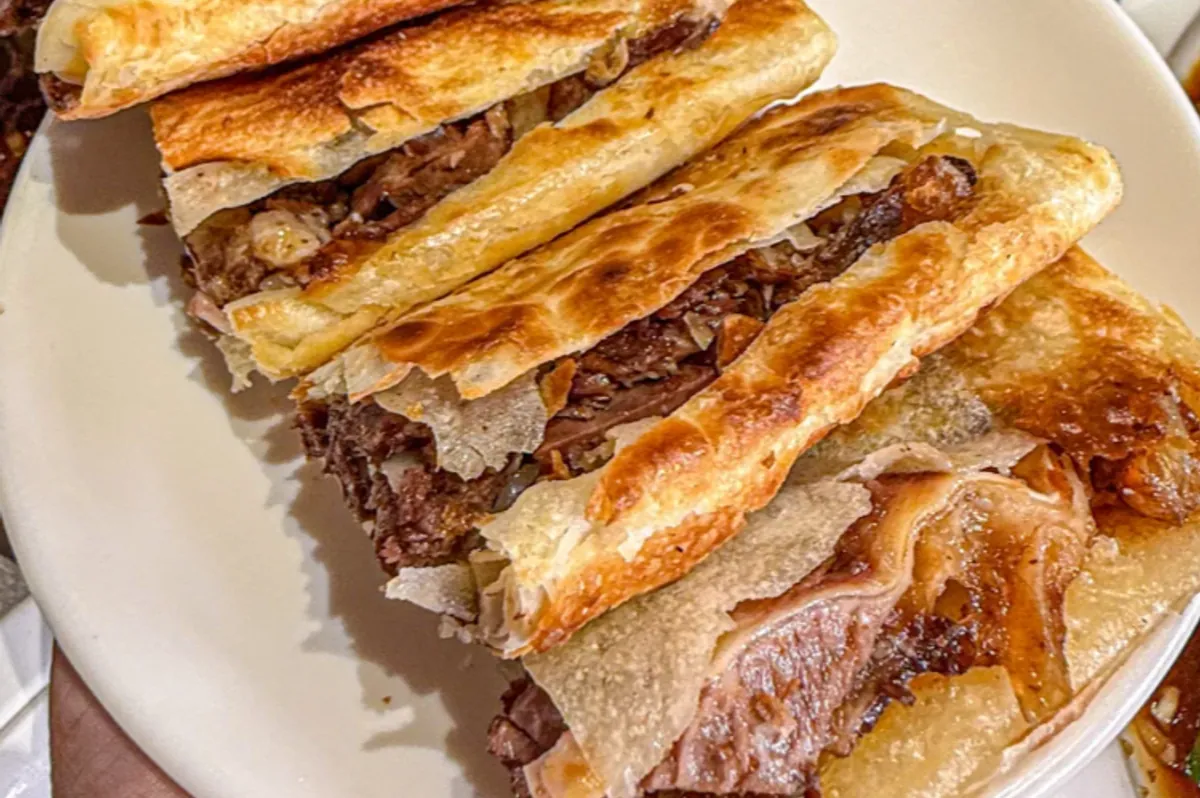
Shredded braised donkey meat stuffed into a crisp, flaky flatbread — think of it as Beijing’s answer to a pulled pork sandwich. The meat is lean, slightly gamey, and surprisingly tender. There’s a local saying: “In heaven there is dragon meat, on earth there is donkey meat.”
Where to go: Wang Pangzi (Fatty Wang) has multiple locations and is the most famous chain. The original shop near Gulou Dajie is a tiny takeout window — order the “chun lürou” (pure donkey meat) version for ¥12–15. Eat it standing on the sidewalk like a local.
7. Candied Hawthorn (冰糖葫芦 Bīngtáng Húlu)
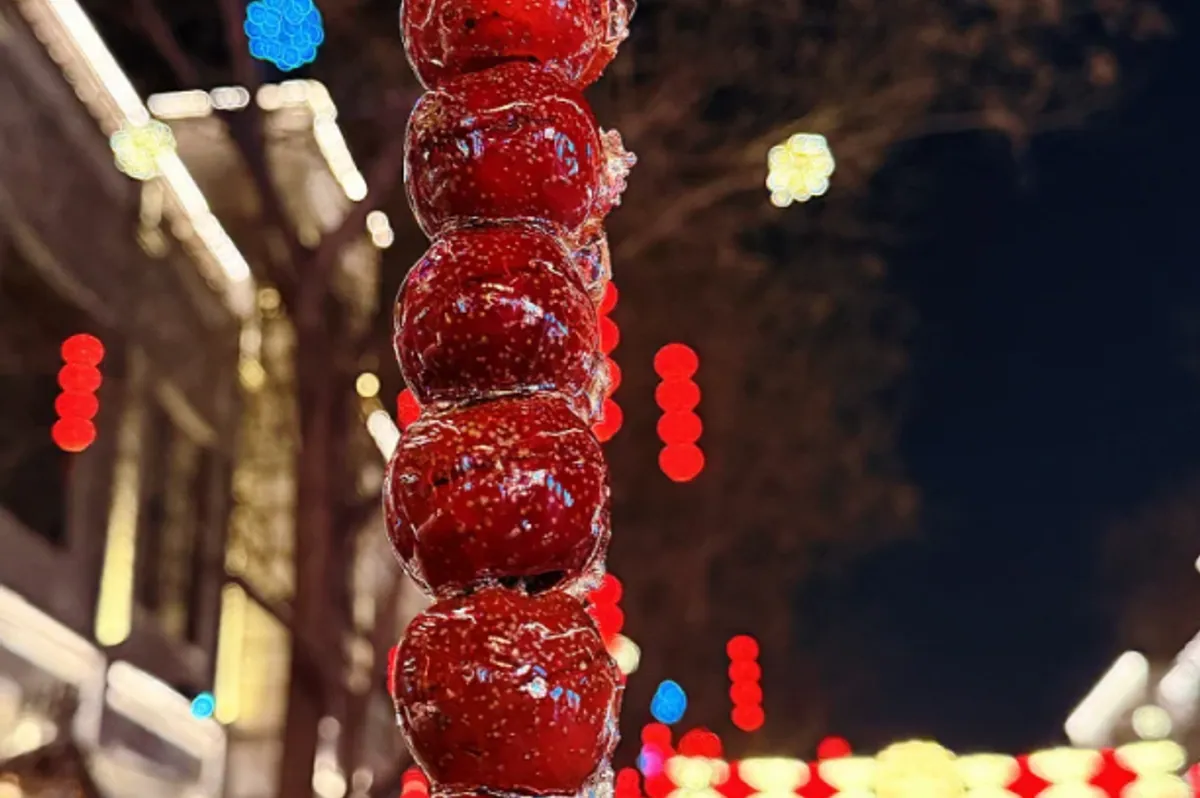
The iconic Beijing street snack: skewered hawthorn berries dipped in hardened sugar that cracks when you bite. The tartness of the hawthorn against the glassy sugar shell creates an addictive sweet-sour contrast. In winter, you’ll see vendors carrying tall foam cylinders bristling with these skewers on every major street. Modern variations use strawberries or grapes, but the classic hawthorn is the one to try.
Where to go: Any street vendor in winter (November–February). The best are near temple fairs during Chinese New Year and along Wangfujing Snack Street. ¥5–10 per skewer. Avoid any that look melted or sticky — that means they’ve been sitting too long.
8. Mung Bean Milk (豆汁 Dòuzhī)
A gray-green fermented drink made from mung beans, with an aroma that visiting foreigners often compare to stinky cheese or sour beer. Beijingers have been drinking it for over 300 years. The flavor is sour, slightly funky, and surprisingly refreshing once you get past the smell. It’s typically served with pickled vegetables and jiaoquan (crispy fried dough rings). Honest verdict: most first-timers won’t finish a bowl, but it’s the most authentically Beijing thing you can consume.
Where to go: Huguosi Snacks on Huguosi Street in Xicheng is the historic go-to, serving douzhi since the Qing Dynasty. The classic pairing is douzhi + jiaoquan + salted pickles (¥8–12 total). Go in the morning when it’s freshly made.
9. Lamb Skewers (羊肉串 Yángròu Chuàn)
Cumin-dusted, chili-flecked lamb grilled over charcoal on metal skewers. This is Uyghur-style street food from Xinjiang that Beijing has adopted as its own. The best versions alternate lean meat with small chunks of fat that render and baste the skewer as it cooks. Served by the handful, best eaten standing around a smoky grill with a cold Yanjing beer.
Where to go: Guijie Street after 8pm — the entire strip turns into an open-air grill festival. Any restaurant with a charcoal grill on the sidewalk and smoke billowing into the street is a good bet. For indoor dining, Huajia Yiyuan on Guijie serves excellent skewers. Budget ¥3–5 per skewer, 10–15 skewers per person for a meal.
10. Luzhu Huoshao (卤煮火烧 Lǔzhǔ Huǒshāo)
A deeply traditional Beijing breakfast: a dark, savory stew of pork offal (lung, intestine, stomach) simmered with tofu, wheat gluten, and a hard flatbread that soaks up the broth. It’s topped with mashed garlic, fermented tofu, cilantro, and chili oil. Describing it makes it sound challenging; tasting it makes you understand why it has a cult following.
Where to go: Beixinqiao Luzhu near Beixinqiao subway station is the most famous purveyor, often with a line out the door by 8am. ¥15–20 for a bowl. Go early; they often sell out by 10am.
11. Beijing Yogurt (北京酸奶 Běijīng Suānnǎi)
Served in small ceramic pots sealed with wax paper and a rubber band, Beijing yogurt is thicker and tangier than Western supermarket yogurt. It’s a refreshing street snack in summer, sold from coolers outside convenience stores and from vendors in hutong alleys. Drink it straight from the pot with a straw, then return the pot.
Where to go: Any convenience store or street vendor in the hutongs. The most famous brand is Sanyuan. ¥3–5 per pot. Look for a cooler marked “suānnǎi” (酸奶).
12. Mala Tang (麻辣烫 Málà Tàng)
Choose-your-own-adventure soup: grab a basket and tongs, pick from dozens of skewers of vegetables, tofu, noodles, meat, and mushrooms, then hand your basket to the cook who boils everything in a numbing-spicy Sichuan pepper broth. Your selections are slid off the skewers into a bowl of broth, topped with sesame paste and crushed peanuts. It’s fast, cheap, and customizable.
Where to go: Zhang Liang Mala Tang (multiple locations) is the dominant chain with clean stores and visible hygiene. Yang Guofu is another reliable chain. Expect ¥15–30 per person depending on how much meat you add.
13. Baozi (包子 Bāozi)
Fluffy steamed buns filled with seasoned pork, vegetables, or sweet red bean paste. Beijing baozi are larger and breadier than the delicate xiaolongbao of Shanghai. They’re the working person’s breakfast — grab four or five from a steamer, dunk them in black vinegar with chili, and eat standing at the counter. Total cost: ¥5–10 for a filling breakfast.
Where to go: Qingfeng Baozi (multiple locations) is the state-owned chain famous partly because Xi Jinping visited one branch in 2013. Pork and scallion baozi are ¥2 each. For something more artisanal, small independent baozi shops in hutong neighborhoods are everywhere — look for the steaming bamboo baskets in the window.
14. Imperial Court Cuisine (宫廷菜 Gōngtíng Cài)
For a splurge meal, Beijing’s imperial court cuisine recreates dishes once served to the Qing emperor and his court. These restaurants operate in restored courtyard mansions and serve meticulous multi-course banquets featuring dishes like Buddha Jumps Over the Wall (a complex soup with abalone, sea cucumber, and shark fin) and elaborate pastries shaped like flowers and animals.
Where to go: Bai Jia Da Yuan (White Family Grand Courtyard) on Suzhou Street near the Summer Palace is set in a Qing Dynasty prince’s mansion with garden pavilions for private dining. Expect ¥300–600 per person. Li Jia Cai near the Forbidden City is more intimate — a family-run courtyard restaurant where the menu changes daily based on what the chef finds at market. Reservations essential for both.
15. Niujie Muslim Cuisine
Beijing’s Niujie (Ox Street) neighborhood is the historic center of the city’s Hui Muslim community, with food traditions separate from mainstream Beijing cuisine. Lamb and beef dominate, pork is absent, and the spice palette (cumin, Sichuan peppercorn, star anise) is bolder. Niujie has been a food destination since the Tang Dynasty.
Where to go: Start at Niujie Qingzhen Supermarket area and eat your way south. Hongbin Lou is the historic restaurant (founded 1853) for formal halal dining. For street food: sesame cakes stuffed with spiced beef at Niujie Minzu Xiaochi, and lamb chuan’r grilled fresh at any stand with smoke coming from it. The neighborhood is ~20 minutes by taxi from the Forbidden City area.
Quick Guide to Beijing Food Streets
| Street | Best For | When to Go |
|---|---|---|
| Guijie (簅街) | Crayfish, lamb skewers, late-night | After 8pm, any night |
| Wangfujing Snack Street | Novelty snacks (scorpion on stick) | Late afternoon–evening |
| Niujie (牛街) | Halal Muslim cuisine | Lunch, Friday prayers |
| Huguosi Street | Traditional Beijing snacks | Breakfast–lunch |
| Qianmen Street | Classic restaurants, tourist-friendly | Lunch, dinner |
| Sanlitun | International dining, cocktails | Dinner, weekend brunch |
Dining Tips for First-Time Visitors
- 1.Meal times are earlier than in the West. Lunch starts at 11:30am and winds down by 1:30pm. Dinner starts around 6pm and the kitchen often closes by 9pm, especially in residential neighborhoods. Guijie Street restaurants are the exception — many stay open past 2am.
- 2.Cashless is the norm. WeChat Pay and Alipay dominate. Foreign cards are increasingly accepted at mid-range and above restaurants, but street food stalls and small family-run spots may be cash-only or QR-payment only. Carry some cash as backup.
- 3.Sharing is the default. Chinese meals are communal. Dishes are ordered for the table and placed in the center for everyone to share. Don’t order one dish per person the way you might in the West — aim for roughly the number of diners plus one dish, shared.
- 4.Street food safety is generally good. Beijing’s street food scene is vibrant and mostly safe. Follow the crowd — busy stalls with high turnover are the freshest. Avoid pre-cooked skewers sitting at room temperature. If a stall has a line of office workers at lunch, it’s good.
- 5.Don’t skip the condiments. Chinese restaurant tables are covered with condiment caddies: black vinegar, soy sauce, chili oil, minced garlic. Beijingers customize every bite. Pour a small dish of black vinegar for your dumplings; add a spoon of chili oil to your noodles.